

Most of us treat fear like a problem to fix. Something to push down, outrun, or meditate away.
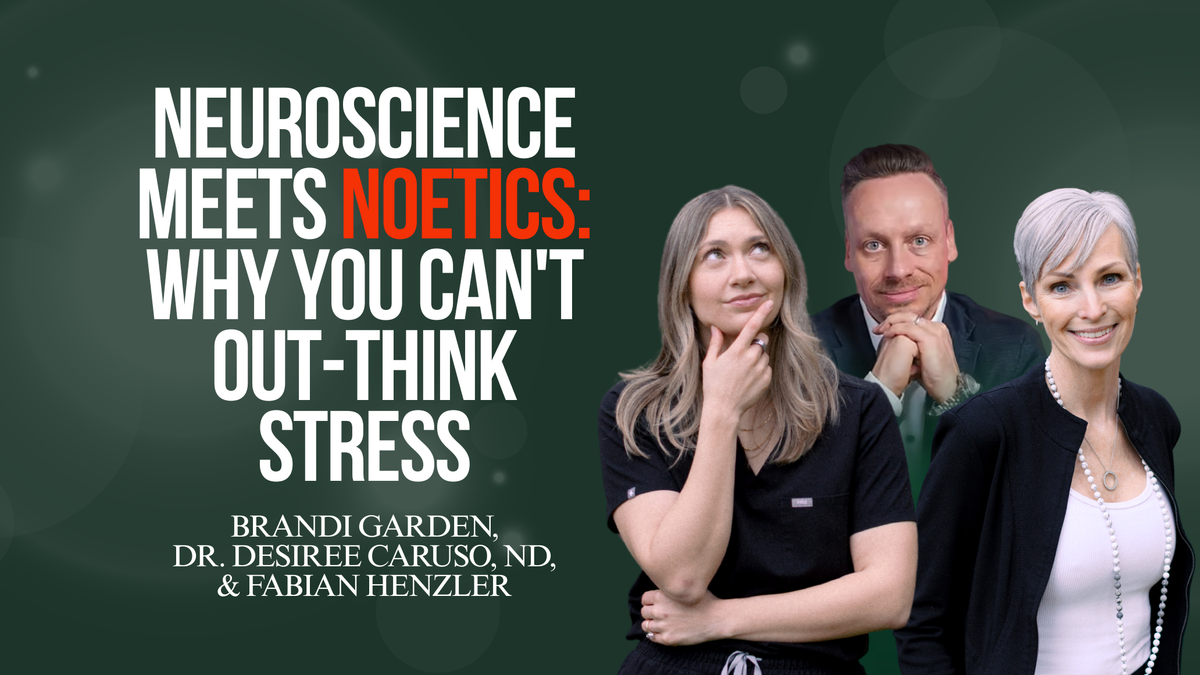
Our friend Fabian sees it differently. On Episode 74 of The Eversio Experience, he says he believes we came here partly for fear. And by the end of our conversation, we had a whole new way of thinking about stress, attention, and what our nervous system is quietly deciding for us every day.
Why This Conversation Matters Right Now
"Nervous system" has become one of the biggest buzzwords in wellness. It's on every feed, in every caption, attached to every product. And yet when Dr. Desiree asks how someone would actually know their nervous system was keeping them stuck, we realized how rarely anyone answers that clearly.
Fabian is a belief systems coach from Germany who has been meditating since he was 15. He studies quantum physics and neuroscience, works with quantum computers, and has been working with us at Eversio behind the scenes, helping us think through what a conscious business looks like in practice. We met him at a meditation retreat, and we've wanted to share his way of explaining things with you ever since.
Here's what we took away.
Fear Might Be Doing Its Job
Brandi shares something she noticed while reading through ancient wisdom traditions: the phrase "do not fear" seems to show up everywhere. And so much of modern life, especially entrepreneurial life, runs on fear.
-
What if we don't make enough money?
-
What if we don't help enough people?
-
What if we run out of time?
-
What if we don't know how to get there?
Fabian's take was the opposite of what we expected. He believes fear is part of why we're here. In his words, the biggest lessons in life are so meaningful because of the fear involved.
His reasoning goes like this:
-
Without challenge, there's no change
-
Without change, there's no learning
-
Without learning, there's no growth
Think back to a moment that shaped who you are today. Odds are, there was something scary in it. Fabian's encouragement: when you feel afraid of what's coming, lean into it, trust yourself, and take action.
Brandi sums it up with one of our favourite lines: we are all faced with great opportunities, brilliantly disguised as impossible situations. If it's easy all the time, you're probably not growing.
Worry Is Not a Plan
Fabian makes a distinction we keep coming back to. Fear can teach you something. Worry, on the other hand, keeps you stuck.
When you project the future based on everything that's happened to you before, you limit yourself to what you already know. His approach is to:
-
Notice when you're spending energy on worst-case scenarios
-
Shift your attention to what you can do well, where you feel safe
-
Take action from that place
-
Let go of the outcome, knowing you gave it everything
As he put it, life happens for you, not to you. That one perspective shift changes how you meet the next hard thing.
Try This: Find Everything Red in the Room
This was the moment in the episode where we both said, "Wait, do that again."
Here's Fabian's exercise. Try it right now:
-
Close your eyes.
-
Picture the room you're in and try to remember everything that's red.
-
Open your eyes and look around.
-
Now close your eyes again and name two things that are blue.
Most people struggle with step four. And Fabian's point is that there were likely just as many blue things around you, if not more. You simply weren't looking for them.
That's selective attention in action. And according to Fabian, it's what a stressed nervous system does to your entire day.
What Your Nervous System Is Doing With Your Attention
Fabian explains it in terms we can picture.
Your nervous system acts like an operating system designed to keep you safe. Back when humans were dodging predators, a narrow focus was lifesaving. You didn't need to notice the flowers. You needed to find the tree you could climb.
Fabian connects this to a brain network called the reticular activating system, which he described as part of what directs your attention toward what matters for survival.
The problem today is that so much of life feels life-threatening, even when it isn't:
-
A tough conversation with your boss
-
An argument with your partner
-
Money stress
-
The fear of losing a job
When you're stuck in that mode, your attention narrows to threats, and you stop seeing opportunities altogether.
The two sides of the system:
-
Sympathetic: the alert, on-guard state. Faster, shallower breathing, a higher heart rate, a narrow focus.
-
Parasympathetic: the rest state. Relaxation, healing, and creativity live here.
Fabian also points out that when something hard does happen, like losing a job, it can open a creative window that leads somewhere better. But you don't have to go through a crisis to get there. You can practice shifting states on purpose.
The Simplest Tool: Your Breath
Fabian's go-to method is slow breathing:
-
Inhale through your nose
-
Exhale slowly and fully through your mouth
-
If you know box breathing, that works too
In his experience, slower breathing widens your focus, makes your brain more open to new information, and helps you see more opportunities than threats.
Brandi says something on the episode that we want to repeat here. You see "breathe" as a one-word tip on Instagram all the time, and it gets lost. When you understand why it works on your attention, it becomes a tool you'll actually reach for.
It's also why we both schedule stillness like a meeting. For Brandi, it's an hour every morning. For Dr. Desiree, sometimes it's part of her lunch break. As Brandi puts it, great creation comes from the unknown. And the unknown doesn't show up in your third meeting of the day. It shows up in the space.
Where Fabian Sees Quantum Physics and Consciousness Meeting
Dr. Desiree asks the question we think every curious listener should be asking: what does quantum physics have to do with human consciousness, and where does established science end and hypothesis begin?
Fabian shares his perspective, and we want to be clear about which parts are which.
What he points to from published research:
-
A well-known study led by Antoine Lutz found that long-term Buddhist meditation practitioners produced high-amplitude, synchronized gamma brainwave activity during meditation, compared with people new to meditation.
What he shares as his own view and experience:
-
That tiny cell structures called microtubules may play a role in consciousness, an idea associated with a theory called Orch OR. Fabian noted that some people support this idea and others don't.
-
That brain coherence around 40 Hz gamma, paired with heart rhythms at about six breaths per minute, creates a special state he connects to quantum effects.
-
That meditation and quantum computing share something: both need stillness and coherence to work.
These are big, still-debated ideas, and we love that Fabian holds them with curiosity. The part we think everyone can use today is the balance he landed on.
One Foot in Each World
Fabian's biggest life lesson, in his words, is that no single theory or practice is 100% right. The idealist who only meditates and the materialist who only grinds are each missing half the picture.
-
Meditate, and then take action
-
Get still, and then get moving
-
Trust the process, and then do the work
Or, as Brandi puts it: sitting on your couch manifesting while eating a bag of potato chips is not a thing.
Before You Go
Here's what we want you to remember from this one:
-
Fear can be a teacher. Worry is the part that keeps you stuck.
-
A stressed nervous system narrows what you notice. The red-and-blue exercise shows you how much.
-
Slow breathing with a long exhale is a tool you can use today.
-
Stillness is where new ideas come from, so put it on your calendar.
-
Meditation and action belong together.
And one more thing: so many of you tell us sleep is the one area you'd most like to improve. The three of us are building something about sleep together. It's a while away, but you heard it here first.









Leave a comment
All comments are moderated before being published.
This site is protected by hCaptcha and the hCaptcha Privacy Policy and Terms of Service apply.