



I have a confession. I was fangirling a little bit brushing my teeth the morning we recorded this episode. Because Andrea Ferguson is not just a guest on this podcast. She is one of the reasons this podcast exists at all.
If you have read my book, you may have already seen her name in the early chapters. She was one of the people who cracked me open right at the very beginning of my personal growth journey, and she has been a quiet force behind so much of what we have built at Eversio Wellness. Craig and I worked with her as a leadership team. She has come to our company retreats and led breathwork with all of us. She has given our whole team a vocabulary and a framework that has made us genuinely better humans and better leaders. So when I say this is someone who has made our lives healthier, I mean it with everything I have.
Andrea has been in the wellness industry for almost two decades. She was a personal trainer, nutritionist, and fitness studio owner before burnout forced her to completely reinvent her approach to life and business. Today she leads the F.I.T. Life Method Academy, a transformational coaching academy for women, and trains coaches in the holistic, trauma-informed method she built out of her own breakdown.
This is one of those conversations that will make you pull your car over. You have been warned.

CHAPTER ONE: The Shadow Calling. When You Are Great at What You Do but It Is No Longer You
One of the most powerful concepts that came out of this conversation is something Andrea called a shadow calling. And I think every high-achieving woman needs to hear this.
A shadow calling is when you are in your zone of excellence. You are exceptional at what you do. People depend on you, your work is meaningful to others, and walking away would make everyone around you say you are crazy. But here is the thing: it is not your zone of genius. It does not light you up anymore.
Andrea lived this firsthand. She had built a beautiful fitness studio in our community. A team of twelve. A loyal community of clients who still talk about that space today, with deep emotion. And in the middle of all of it, she would go and do a coaching session and completely light up, and then return to anything studio-related and feel numb. Frozen. She would sit at her computer screen and not know what to do. She would lie on the floor of her office and ask, "What do I do?"
She resisted the truth for about eighteen months. Her identity was completely wrapped up in that studio. The investment of time, money, energy, and love was enormous. And she had a team of people she felt responsible for. Sound familiar?
What finally cracked it open was the moment she stopped resisting and gave herself permission to admit what she actually wanted. She cried on the floor of her office. And in the moment of that admission, she described something I think we all need to hear. It was not devastation. It was relief.
As soon as she let herself say it out loud, things started falling into place. And what she said next stopped me cold: staying stuck and forcing herself to stay was so much harder than navigating the transition. Working against a brick wall was more exhausting than anything the change brought.
If you are sitting in a shadow calling right now, this is your permission slip. Not to blow your whole life up tomorrow. But to start listening.

CHAPTER TWO: What Burnout Actually Looks Like for High-Functioning Women. The Default Loop
This is the part of the episode that I think our Eversio community is going to recognize in themselves, and I need you to stay with it even when it gets uncomfortable.
Dr. Desiree asked Andrea to describe what a default pattern looks like in the day-to-day life of a high-achieving woman. What she laid out is something she calls the hustle for worthiness, and it runs most of our lives without us even realizing it.
Here is the framework she shared. From a very young age, we learn who we need to be in order to feel significant, safe, accepted, and loved. Instead of just showing up as our truest selves, we begin asking, "Who do I need to be in order to...?" And we build our whole lives around the answer.
Andrea outlined five key self-worth traps:
- Achievement: being productive, performing, accomplishing, behaving well.
- Appearance: looking polished, put-together, in control.
- Status: measuring your worth by outward markers of success, what you have, who you know.
- Caretaking: putting everyone else first, being the person who holds it all together, only feeling valuable when everyone around you is happy.
- Giving: overextending, being generous to a fault, tying your worth to the impact you make on others.
Do any of those hit a nerve? For a lot of us, it is more than one.
What happens next is what Andrea calls the default loop. To protect your sense of worth and safety, you wake up and perform. You work hard, say yes, overcommit, and carry more than your share. You are the highly capable, highly responsible person everyone counts on. Letting people down feels intolerable, so you just keep adding more. Then you overload. And then you crash. The bag of chips. The glass of wine. The three hours of scrolling on the couch at the end of the day, not actually resting at all, just flipping between one kind of numbing and another.
And then the self-judgment kicks in. "I just need more discipline. I need to get my health in check. I need to do more to be better."
And then the cycle starts again.
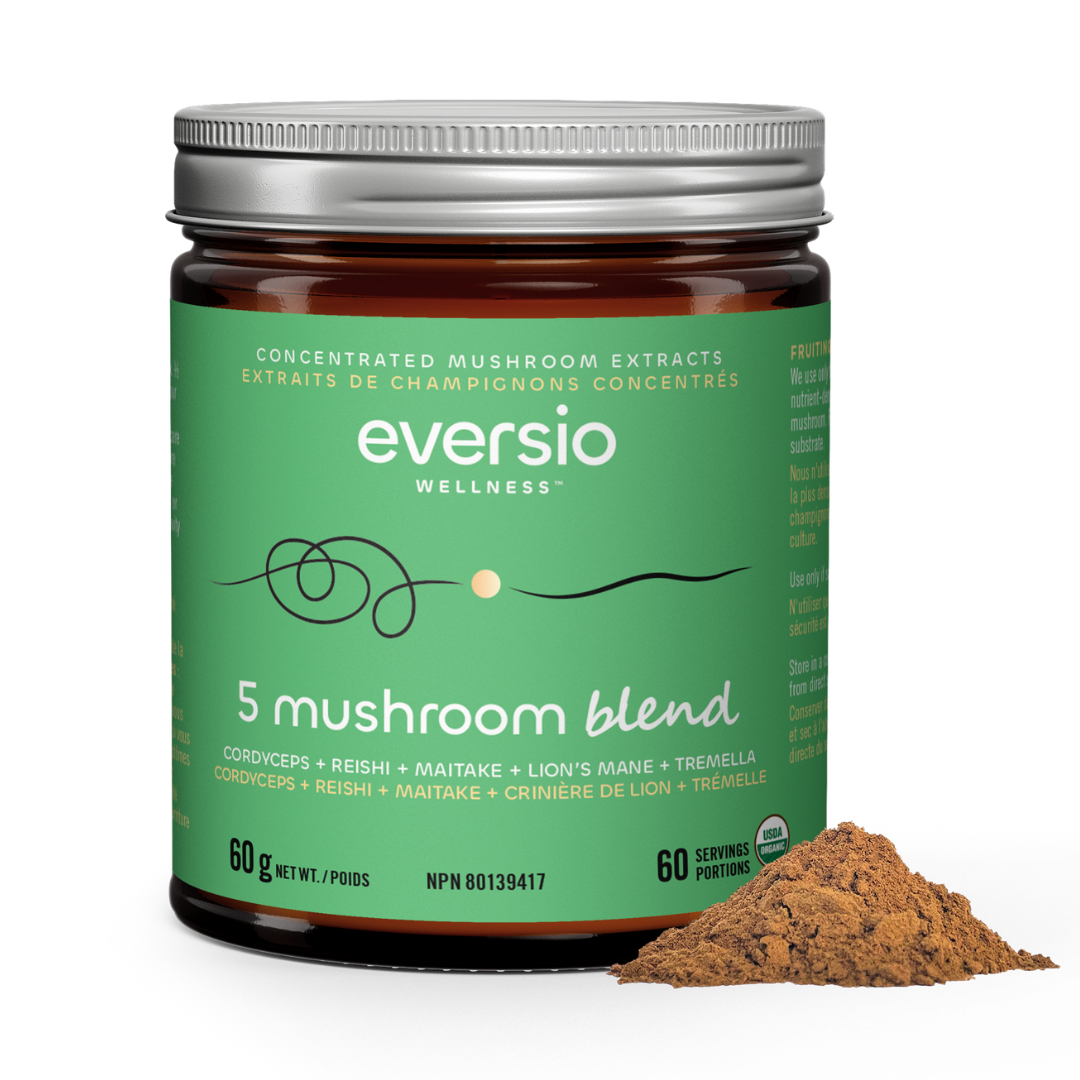
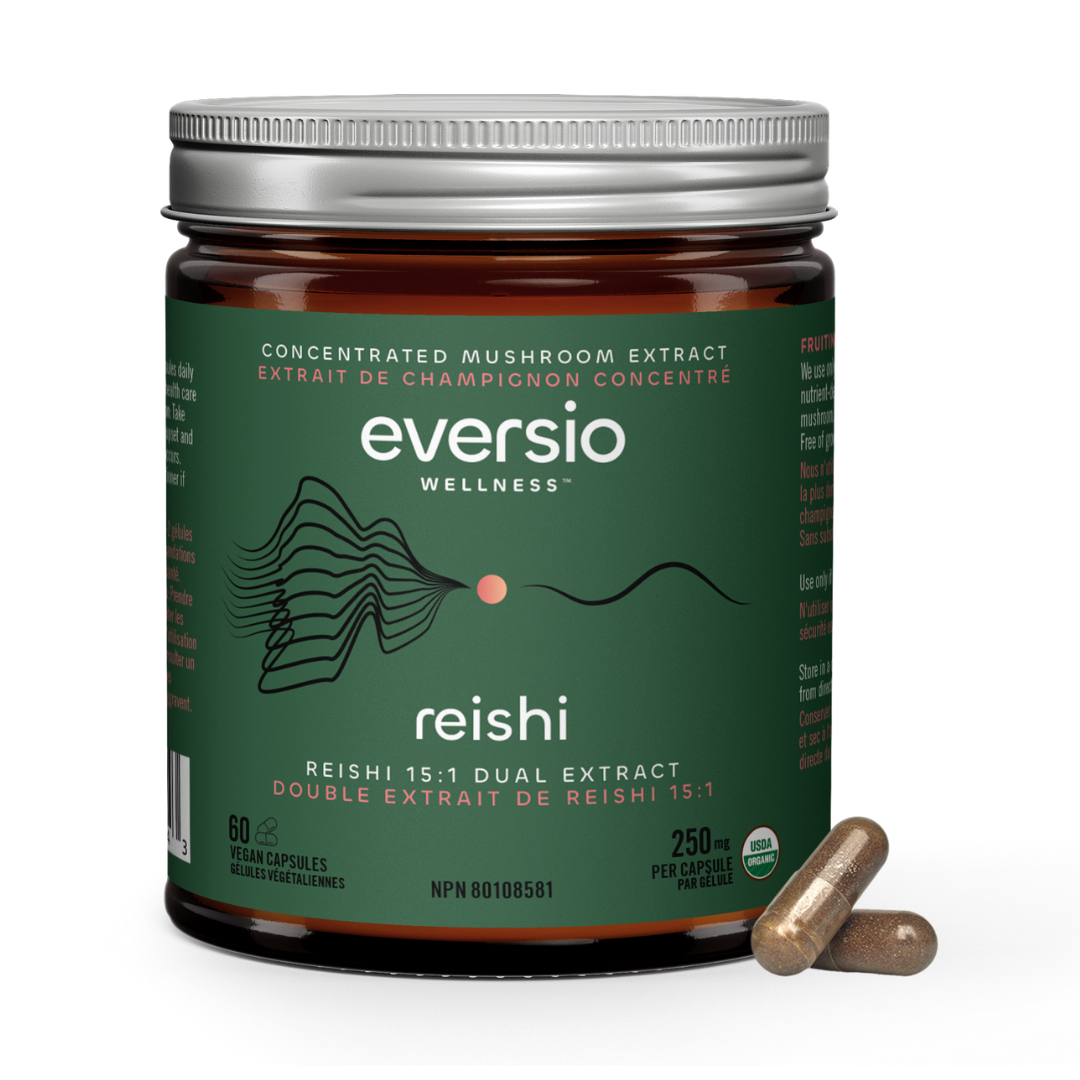
Here is the part that I need our community to really absorb, because it connects directly to why we built Eversio. That woman in the default loop is the same woman who used to walk through the doors of Andrea's fitness studio and say, "I just need to lose weight. When I lose weight, everything else will be fine." The same woman who comes to us because she thinks she needs a reishi mushroom to sleep better. And yes, the reishi helps. We call it the small win. But it is never the whole thing.
Physiologically, when you are stuck in fight-or-flight mode, you are never going to lose the weight. You are never going to find the sleep. Because you are running on a nervous system that does not feel safe to slow down.

CHAPTER THREE: The Difference Between Coping and Internal Capacity (This Is the One)
Dr. Desiree asked Andrea what I think is the most important question in the whole episode: what is the difference between coping and true internal capacity?
Because most high-achieving women are excellent copers. They have done the therapy. They have given up the wine and picked up the yoga. They have dropped the yoga and started the cold plunges. They are listening to podcasts. They are doing the things. And yet nothing fundamentally shifts.
Here is what Andrea said, and I want you to really sit with it.
Coping is about escape and relief. It is "I just need to get through." It gives you just enough release to stay in the loop without actually changing the pattern underneath. The over-functioning part of you and the bag of chips at the end of the night are actually the same thing. Both are the nervous system trying to regulate. Neither of them is wrong. Both of them are intelligent adaptations. But neither of them builds the muscle.
True internal capacity is what allows you to actually handle what life brings without swinging from overdrive to collapse. Andrea described it as a window with two edges. At the top, you are in hyperarousal, your over-functioning, over-achieving, over-giving state. At the bottom, you are in hypoarousal, the collapse, the Netflix couch, the scrolling. Most high-achieving women are just swinging between the two, and the middle zone, what she calls the optimal zone, is either missing or razor thin.
Building internal capacity means growing that middle zone so you do not need a vacation to feel like yourself. So you can navigate real life, real challenges, and real relationships from a place of genuine steadiness rather than white-knuckling it and calling it discipline.
She said something here that I think about all the time with regard to what we do at Eversio. Physical wellness is essential. We will never tell you to stop sleeping, moving, nourishing your body. We call those the boring basics and you are not getting out of them. But no amount of perfect sleep hygiene or supplements can fully compensate for a nervous system that does not feel safe, for chronic emotional suppression, for being stuck in overdrive.
You have to go deeper.

CHAPTER FOUR: The Body Is Not Betraying You, It’s Talking
"The body is a reflection of the internal state."
Andrea said it and I asked her to say it again for the people in the back.
Your body is not failing you. It is not broken. It is the most honest thing about you. It is showing you, in the most dominant and consistent way it knows how, what is running underneath. Your relationships are also a reflection of your internal state. Your energy levels. Your sleep quality. Your relationship with food. All of it is a mirror.
What gets most of us stuck is believing that if we could just fix the body, everything else would follow. We come in through the physical door first. That is how most of us arrive at any kind of transformation. We want to lose weight. We want more energy. We want to stop waking up at three in the morning with our hearts racing. And those are real and valid entry points.
But if you have been working at the level of behaviors and not making the internal shifts first, you will keep cycling back to the start. Awareness is not enough on its own. Knowing you are a people pleaser and deciding to set boundaries does not automatically rewire the nervous system that has been running the people-pleasing program since you were seven years old.
That is what Andrea means when she talks about integration. Awareness plus new behaviours plus genuine somatic integration is what creates change that actually lasts.

CHAPTER FIVE: Trauma-Informed Does Not Mean What You Think It Means
I know some of you just tensed up when you read the words "trauma-informed." Stay with me.
Andrea is incredibly intentional about using this language because she wants high-functioning, successful women to understand that it applies to them. It is not only for people with a capital-T trauma history.
What trauma-informed really means, in the context of her work, is understanding that your past experiences have shaped your current reality. Your current patterns, your behaviors, your responses to stress, none of them are problems to fix. They are intelligent adaptations. They were once forms of protection. They made sense given what you were navigating.
A trauma-informed lens asks, "What happened to you?" instead of "What is wrong with you?" And that reframe changes everything about how change becomes possible.
In a traditional coaching or wellness model, there is often pressure, intensity, willpower, no-excuses energy. Push through. Get harder on yourself. More discipline. And for a woman whose nervous system is already chronically overwhelmed, all that pressure does is add more load to an already overloaded system.
Andrea's approach is about developing safety first. Meeting people where they actually are, not where we think they should be. Creating the conditions for genuine nervous system regulation so that change can happen from the inside out, not from more external forcing.
As she put it: real, lasting change requires developing the internal capacity to handle change. You cannot shortcut that with willpower.

CHAPTER SIX: Rhythm Over Discipline — A New Way to Think About Consistency
I want to stay on something that Andrea said near the end of our conversation, because it cracked open a word that I think a lot of us have a complicated relationship with.
Discipline.
For so many of us, the word has a hard edge to it. It sounds like military. Like punishment. Like something you impose on yourself when you are not doing well enough. And in that energy, discipline just becomes more pressure, which is more of the same loop.
What Andrea offered instead was the word rhythm.
She said when you learn to trust your internal rhythms and listen to what your body actually needs, consistency is naturally born from that. It is not an effort. It is an honoring. It is nourishing. It becomes the natural extension of caring for yourself, not a performance metric.
For those of us who track things like HRV or readiness scores, this can show up in fascinating ways. I have watched my own data over time and seen in real numbers how much time I was spending in my stress state. Not because something catastrophic was happening, but because my baseline was set to overdrive. Seeing that reflected back was one of the things that made the work we have done together feel undeniable. I am not crazy. And the changes are real.
Andrea puts it this way: your routine and your practices should be a reflection of who you are, not a checklist you borrowed from someone else's Instagram morning routine. When it is truly yours, it does not feel hard. It feels like coming home.

CHAPTER SEVEN: The First Thing to Do If You Know Something Needs to Change
For the woman who is somewhere between "I know something needs to change" and "I have no idea where to start," here is what Andrea said directly.
Give yourself permission to listen.
Not the kind of listening where you open a wellness app and follow a program. The kind of listening where you get honest, maybe for the first time, about what you actually want. Not what your role requires of you. Not what your family needs from you. Not what your business demands. What you want.
From there, she said: get curious about emotional regulation. It does not have to be a deep dive on day one. Just a sense of wonder about it. What does it mean? What would it look like in your life? What are the next small steps?
And here is the question I want to leave you with, because I think it is the most clarifying one I have found: how do you respond to stress? When something comes at you, what is your reaction? And then how long does that last? How much of your life are you asking yourself to sit in emergency mode over something that happened an hour ago, a week ago, five years ago?
The level of emotional intelligence you carry is directly related to how quickly and how gracefully you can move through what does not go as planned. And if that number is not where you want it to be, that is not a flaw. That is a place of growth. And there is someone who has walked the path and is ready to walk it with you.

CHAPTER EIGHT: Why We Trust Andrea With Our People
At Eversio, we never recommend something we have not done ourselves.
Craig and I started working with Andrea in the early days of building this company. She helped us understand what conscious business felt like. Those conversations were not easy. She asked us to look at ourselves honestly and to lead differently. And because we felt so genuinely changed by that work, we brought her to our team retreats. She has done breathwork with all of us. She has given us a shared language, the backside of the spiral, fully in tune, the window of tolerance, that has made us better at what we do and better to each other.
Every single person on our team has worked with Andrea. And that is why she is here today.
The F.I.T. Life Method is built around the acronym FIT, which stands for Fully In Tune. When we live fully in tune in body, mind, and spirit, we live our most fit life. That is not a tagline. That is the entire philosophy.
If you are ready to stop managing the symptoms and start doing the work that actually moves the needle, we cannot recommend Andrea and her team more highly.
You can find her and book a right-fit call (yes, pun very much intended) at FitLifeMethod.com and on social media at @TheFitLifeMethod.
She also trains coaches in her holistic, trauma-informed method through the Fit Life Method Academy, so if you are a coach or aspiring coach who wants to do this work in the world, that is worth a look too.
Until next time.
Be well,
Brandi Garden.









Leave a comment
All comments are moderated before being published.
This site is protected by hCaptcha and the hCaptcha Privacy Policy and Terms of Service apply.