
Imagine being ten years old and quietly accepting that you got a bad personality. Not as a phase. As a permanent trait, like height or eye colour.
That's exactly what Dr. Angela Kingdon believed about herself. She knew she was smart. She knew she was a gifted writer. And she was certain that the rest of her was just broken.
It took decades, and an autism diagnosis, to learn that nothing was broken at all.
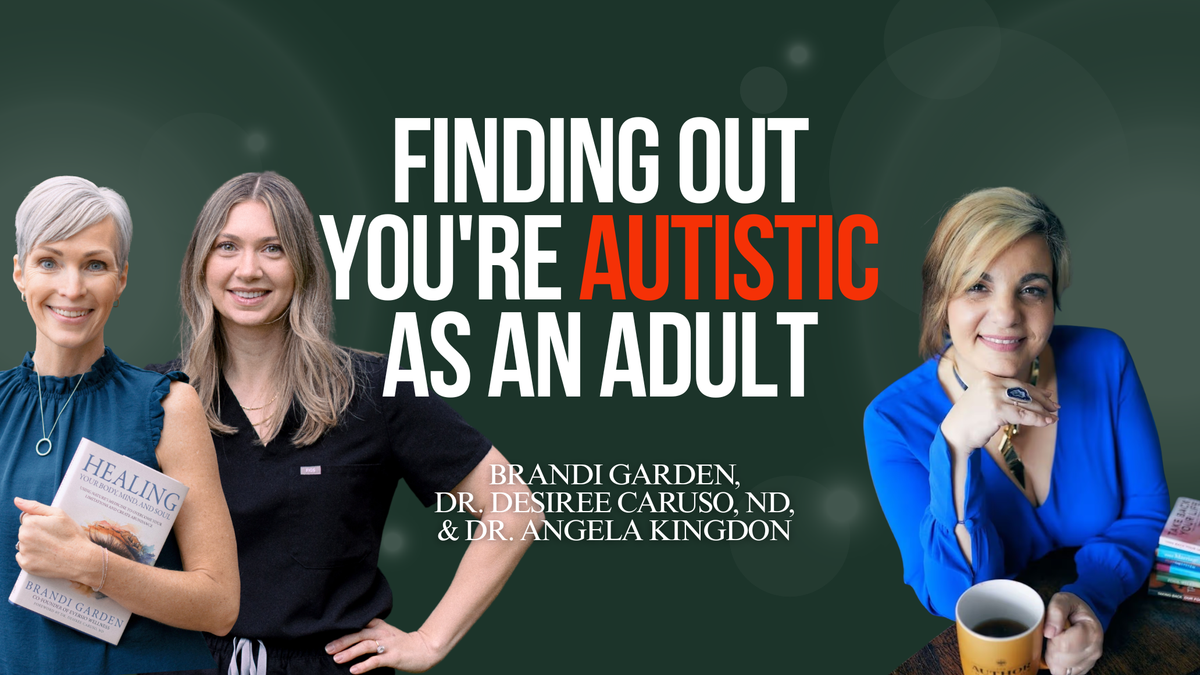
Angela is an autistic author, podcaster, and cultural advocate. She's the founder and executive director of the Autistic Culture Institute, co-founder of the Autistic Culture Podcast Network, host of the Late Diagnosis Club podcast, and author of Am I Actually Autistic? She joins us on the Eversio Experience Podcast for a conversation that touches on classrooms, masking, brainwaves, and why so many adults, especially women, are only now finding answers.
Here's what we're taking away.
Why this conversation matters right now
Most of our listeners are women. Many of us grew up in an era when autism was rarely diagnosed, and almost never in girls. That means there are very likely people reading this who are autistic and don't know it.
Brandi knows this firsthand. After twenty years as an elementary school teacher, with a child with autism in her class every single year, she assumed she'd recognize an autistic adult. Then a colleague at Eversio Wellness casually mentioned her own autism over a ping-pong game. Brandi had no idea. She literally dropped her paddle.
Autism in adults often looks nothing like the textbook picture many of us carry around. Angela helps us understand why.
From "bad personality" to beautiful swan
Angela's earliest memory of feeling different comes from religious education class. She pictured God handing out gifts at birth: some people got beauty, some got height, some got intelligence. She got intelligence. And, she figured, a bad personality to go with it.
The outside world kept confirming it.
Teachers pulled her into the hallway to tell her she was the most gifted writer they'd ever taught, but that people wouldn't like her unless she changed.
Employers called her the best team member on staff while telling her nobody wanted to work with her.
She was sent to coaching and therapy to fix the "broken part."
To describe her diagnosis, Angela reaches for a children's story. Hans Christian Andersen, she notes, had many autistic traits, and she reads his stories as autistic stories. Getting diagnosed, she says, felt like the ugly duckling discovering it was a swan.
Of course she was terrible at being a duck. She was never a duck.

What left-handedness teaches us about autism diagnosis
One of the most helpful frames Angela offers is a story about her dad.
He was born in the 1940s and was left-handed. At school, his left hand was tied behind his back, and nuns would smack his hand with a ruler when he used it. By the 1960s and 1970s, attitudes shifted. Left-handedness was understood as simple human variation. Angela's sister, who is left-handed, grew up writing however she wanted.
Angela shares that in her dad's generation, around 3% of people identified as left-handed. A generation later, it was around 12%. And then it levelled off. That wasn't an epidemic of left-handedness. It was people finally being allowed to be who they already were.
Angela sees the same pattern with autism:
When she was a student, autistic girls were essentially invisible.
When Brandi was teaching, maybe a few percent of kids were being identified.
Today, more kids are diagnosed early. Angela's own child was diagnosed at seven or eight.
Adults over 30 are the gap in the middle. Like Angela's dad, who still mostly uses his right hand today, many of them have spent decades conditioned to hide their natural way of being.
Masking: the exhausting work of playing a character
Masking, also called camouflaging, means knowing the "right" way to act and performing it, even when it isn't what feels natural.
Everyone masks sometimes. You put on a smile at the DMV when you're sick. You nod along with a boss you don't love. The difference, Angela explains, is that autistic people often do it all day, every day. You wake up and step into character: today I'll be playing Angela, but without autism.
That constant performance has real mental health costs. One of them is losing track of who you actually are.
Angela's favourite metaphor comes from home. Her husband grew up in a part of England whose accent sounds a lot like a classic movie pirate. He trained himself out of it for the stage, but when he's tired, it slips back out. Masking works the same way, she says. It holds until you're exhausted, and then the real you comes through, sometimes as a meltdown or a moment of bluntness that has real consequences.
Why girls and marginalized people were missed
Angela shares that women, people of colour, queer people, and anyone with multiple marginalized identities tend to be better at masking. "Better" is in quotes here, because the reason is painful: the cost of not masking is so much higher.
She remembers a boy in her class who was diagnosed. He and Angela were very similar, she says, but early autism research was built around boys like him, so that's what people knew to look for.
Girls, meanwhile, were handed expectations instead. Angela was once assigned a 500-word essay titled "I will sit like a lady." Her literal autistic logic: I am a lady, I am sitting, therefore I am sitting like a lady. How do you get 500 words out of that?
The good news is that diagnosis is catching more people now. Angela credits a big part of that shift to autistic people themselves stepping into research, psychology, and conference stages under the banner of "nothing about us without us." Interests that count toward diagnosis have broadened too. It's no longer just trains. It can be hair and makeup, Taylor Swift, or, in Angela's case, twenty years of devotion to the band Crowded House.
Curb cuts for classrooms
Brandi asks a question many teachers carry: how much support does an autistic student actually need?
Angela answers with a question of her own. If you used a wheelchair, would you want people on every corner to lift you across the street, or would you want curb cuts so you could cross on your own?
Curb cuts, every time. And curb cuts help everyone: strollers, crutches, cyclists, people recovering from knee surgery.
Angela believes schools need the same kind of universal design. She describes her eighth-grade English teacher, who wrote a second lesson plan just for her. Angela's point: we don't need two lesson plans. Every child in the room could use their own. She sees AI as one realistic path toward that kind of customization, alongside teachers who facilitate the arts, sports, friendships, and community every child needs.
For Brandi, who still has many friends in teaching, this reframe lands hard. So many teachers carry the belief that a child isn't thriving because they personally aren't doing enough.
It's not mind reading, it's pattern matching
Brandi remembers one student, Charlotte, who seemed to read her mind. Angela offers a different explanation.
As babies grow, the brain goes through synaptic pruning. We actually lose connections, and that loss is what lets us focus, walk, and speak. Angela explains that many autistic people experience less pruning. That can make some things harder, and it can also make the brain take in far more. She shares that autistic brains process significantly more information even at rest.
Picture walking into a packed arena and seeing every face and hearing every voice at once. If you stayed calm, people would call it a superpower. If you screamed and needed to leave, people would call it bad behaviour. Angela says it's the same brain either way.
Add in a lifetime of deep focus, and you get what looks like magic. Angela reads around 300 books a year and has since early childhood. She can hold a book and tell you what's in it from the cover's age, the printer, the page count, and the subtitle. To her, it's simply what happens when you've read that much.

Meditation, brainwaves, and eyes wide open
This part of the conversation lights us up.
Most meditation guidance starts with "close your eyes." For many people, that helps the brain settle into a calmer alpha state. Angela finds that many autistic people experience the opposite. With eyes closed, they go into high alert, listening for what's happening and where they need to be. A soft, open-eyed gaze helps them feel safe enough to settle.
A few more things Angela shares:
Walking meditations work much better for her. She once made a figure-eight route through her own home.
Structured breathing patterns like box breathing can tip her into hyperventilation.
She suspects many autistic people are harder to hypnotize.
She dreams in words rather than pictures, sometimes waking up with whole pages of text.
If closed-eye meditation has never worked for you, that may not be a failure of effort. Your nervous system may simply need a different door in.
What we're taking with us
A "bad personality" might actually be an unrecognized neurotype.
Late diagnosis is a generational gap, not a trend.
Masking is exhausting, and the people who mask hardest are often the ones who were missed.
Support that works for autistic kids, like curb cuts, tends to help everyone.
Wellness practices aren't one-size-fits-all. Eyes open counts.
If any of this stirs something in you, we'd love for you to hear Angela tell these stories in her own words.









Leave a comment
All comments are moderated before being published.
This site is protected by hCaptcha and the hCaptcha Privacy Policy and Terms of Service apply.